The focus is on game mechanisms - what makes a game exciting and why. How did the board game designer make his game fun? Components and theme are secondary. The play's the thing.
Showing posts with label Reiner Knizia. Show all posts

Saturday, March 01, 2008

What is this board game about?

Printer friendly

"So what is this game about?" is the natural first question you might ask when someone brings out a new board game for you to try. That question can have one of two answers, depending on the angle you look at the game from: theme or mechanics.


"The game spans 1500 years of Egyptian history. You goal is to influence Pharoahs, build monuments, farm on the Nile, and advance the culture of the people in an attempt to appease the god of the Sun."


"Okay, but what is the game about?"


"It is a set collecting and auction game. There is a wide variety of tiles that you'll collect, which combine in myriad ways to score points. On your turn, you'll decide whether to add one more tile to the pool, or to auction off the ones already there. Your goal is to collect those tiles which will be most valuable to you, prevent your opponents from getting too many tiles valuable to them."


Either of the above is a reasonable description of Reiner Knizia's "Ra". Since this is the Journal of Boardgame Design, I'm interested almost 100% in the latter. Either description could reasonably be called the game's "theme", but in practice "theme" has come to mean the historical context in which the game supposedly takes place. The designer drapes a bunch of mechanisms around the theme, and he has a game. Maybe the mechanisms are closely tied to the theme and often, in Eurogames, they aren't.

A game, at its best, is more than a bunch of mechanisms. It is a coherent system of mechanisms with a theme of its own. Let's call this theme that summarizes the system of mechanisms the game concept. There is nothing to prevent a game built from a bunch of connected mechanisms from being lots of fun, but I think that having a strong game concept takes the game up a level. It helps to focus the players' goals. It adds meaning to the game apart from the theme. It defines the game.

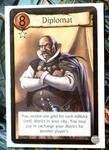
"Players choose among a series of actions which help them to score points, gain resources, or avoid catastrophes. The more you are able to take the same action during the game, the more valuable it becomes. The trick is that in each turn, a player is presented with three possible actions, and he must decide which one to play, and which ones to make available to the players to his left."

-Notre Dame

I enjoy explaining game rules, and I always introduce the game by first describing the game concept. Every rule has a role in supporting the game concept. If players can wrap the whole idea of the game around their heads, then all the individual rules ought make sense. Players can sit down and get to work at trying to win. If they can't get the game concept, then most likely you'll see the "deer in the headlights" look. "Okay, you explained the game to me but... what am I supposed to do?"

The issue of game concept surfaced when I recently first played "Amyitis" by Cyril Demaegd. On any given turn, a player will take one of five different actions. The Merchant and Peasant each give you distinct types of resources. The Engineer gives you immediate points and a shot at a majority battle, for more points, on the main part of the board. The Priest lets you take part in a different majority battle in a small part of the board, which help you win more points or resources depending on where you choose to play. Finally you may move the caravan - in which you spend the resources you earned elsewhere to earn: points from cards, income, faster caravan movement, or the ability to earn points on the main board, which in turn is limited by choices made by players who chose the Engineer earlier in the game.

Deep breath.

So the game Amyitis is about... I'm not sure.

Cyril Demaegd has a defense of the structure of Amyitis which is worth reading. He described it as having a "star structure" rather than a "line structure". I think I understand his point. Some games, ones with a linear structure, have their elements lined up like dominoes. The first one effects the next one, and so on down, until the last mechanism which affects the victory conditions. "Power Grid" by Friedmann Friese is an example of this. You buy power plants, which give you capacity to use fuel. You buy fuel that fills your plants, and together they can power your cities. You extend your network of cities, which when powered give you victory points, as well as income that feeds the entire cycle for the next game turn.


What I think is meant by a "star structure" might correspond to what Americans call a "wagon wheel" or "hub and spoke" structure. There is a core mechanism and several secondary mechanisms. The secondary mechanisms may be independent, but they all affect the core mechanism.

The problem is that there is no core mechanism in Amyitis. The garden, which does take up the most physical space on the game board, really turns out to be just another way of scoring points that is not obviously more important than any other. Here's my picture of the Amyitis structure, which looks more like the floor plan from a spy movie than a wagon wheel.


From all this, it may come as a surprise when I say that I think Amyitis is a hell of a lot of fun. There are some very clever mechanisms in the game, and notwithstanding the nightmare diagram above, the interrelationships play well. However, playing Amyitis is a little like playing with sand. It can be lots of fun, but there is nothing to hold on to. A strong game concept doesn't make a game good. It makes a good game more substantial and more satisfying, and it serves a similar role that a good theme does.

Sometimes having one strong central mechanism that ties the others together can provide a game concept. The hub and spoke diagram above shows a game with many mechanisms which all affect a central one, which in turn provides the victory conditions.


"Caylus", by William Attia, does this, but works the other way as well. The central mechanism is the road, which players build upon and which provides the actions players must choose from. The road is also where the "provost" moves, and he can wipe out some players' actions depending on where they lie on the road.

"Players take actions on the road which gives them commodities, and then they use those commodities to create more buildings on the road (as well as the castle) to earn victory points." That's the whole game summed up in 32 words. Unless you're writing copy for the game box, being able to sum up a game in 32 words or less is no particular virtue. However, it shows that the game is well focused, with a strong game concept that ultimately ties together many mechanisms into a cohesive game. Players sit down to a game of Caylus with a strong sense of what they are doing, purely in terms of the game's mechanics.

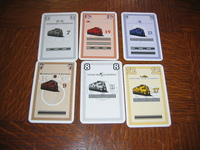
A game can seem more complicated than it is when its game concept is weak. Many people regard Reiner Knizia's "Stephensons Rocket" as a complex game in spite of the fact that its rules are remarkably compact. Its rail building theme is pretty good - but what exactly are you trying to do with those railroads? You want to control them of course. But that only pays off at the end. Meanwhile, you want to run them in to cities, but only after you build stations that you ran the railroads into first. You also want to control the cities that you run the railroads into, and you want to control the commodities that each city produces. Finally, you want to merge the railroads in a way that insures you control the really big railroads at the end of the game. Whew.

In a public appearance, Reiner Knizia once said that scoring and victory conditions are good things to manipulate to get the players to do what you want. In the case of Stephensons Rocket, he took his own advice too well. He made the game work by tinkering with the scoring mechanisms at the cost of maintaining a strong game concept. The final product is a good game, but at times it seems to be a runaway train that is in constant danger of running off its rails.

Conversely, even a complex game can be held together with a combination of strong game concept and theme. Karl Heinz Schmiel's "Die Macher" holds together remarkably well despite being one of the most baroque of all German games. It takes about 45 minutes to teach the rules for Die Macher, and each turn has 13 phases. I don't think too many players would tolerate that sort of complexity if its mechanisms didn't tie so well to its election theme. When a theme is strong, the theme merges with the game concept. "Players represent political parties, each trying to get as many votes in regional elections as possible, which earns you points. You'll attempt to manipulate your party's policies and public opinion in order to get votes in those regional elections. Success in those elections in turn enables you to control the national agenda, which scores you more points." Along with Die Macher's strong theme, and the way it successfully bonds its mechanics to its theme, Die Macher has a strong central mechanism which gives it a strong game concept. Everything flows in and out of the regional elections. You manipulate policies, you buy media, you place party markers, and you manipulate your local popularity all in an effort to gain influence in the local elections. After you've scored your points there, the regional elections affect the national board which gives you money and points for the endgame scoring. Die Macher holds rather well to the spoke and hub model, with somes spokes pointing in to the hub, and others pointing out from it.

Die Macher benefits from both a strong theme and a reasonably central mechanism to maintain some conceptual unity. As games move along the spectrum from "Eurogame" to to "Simulation", the mechanics tend to blossom around the need to recreate reality rather than to maintain any conceptual unity. When a game is primarily a simulation, then the theme becomes the game concept. Imagine "Squad Leader" or "War of the Ring" as an abstract game and the rules would make no sense. Why create all these special exceptions and unique units? How can anyone possibly understand what is supposed to be going on? Once you realize that you are simulating small unit fighting or the battle for Middle Earth, everything comes together. The games remain complicated, but every mechanic serves the basic concept of the real world (or fantasy world) simulation. As long as the players understand what is being simulated, the mechanics hang together conceptually.

Games most often build their game concept around a central dominating mechanism which all others relate to. Are the other mechanisms truly secondary, or do they take on a life of their own? If those secondary mechanisms become significantly complex, the game can lose its focus. Compare Caylus with Age of Empires III by Glenn Drover. Both use a similar action selection mechanism, but Caylus is a more straightforward, focused game, while Age of Empires III adds a lot of extra stuff behind each possible selection and is a more baroque design.

In Caylus, actions taken on the road generally give a player resources or allow him to spend resources on a building. The entire game is about acquiring and spending resources effectively. There are other choices in the beginning of the road - and these create a little metagame around the use of the road: they control items such as turn order, the cost of an action, and which actions on the road will actually occur this turn.

In Age of Empires III one feels as though he is playing four games at once There is the entire colonization battle for majority control off on the side - but one need not participate in that game wholeheartedly. There is a separate module dealing with collecting trade goods. There is the "discovery" game which sets the stage for the colonization game, but has its own set of goals and victory points. Then there is the action selection game which determines how many resources you bring to bear in the other three games. These games-in-a-game all intersect and collide but without truly building upon each other. The theme of colonization just barely stitches this patchwork together.

"Puerto Rico" by Andreas Seyfarth may be the great enigma when it comes to the notion of game concept. There are many facets to the mechanics. Each one is essential and none seems to dominate. Is the game about the role selection? The selection of roles is a central and original concept, but I think it dominates the game much less than does the road and the selection of actions in Caylus. The specifics of the actions - which building to buy, where to put your colonists, your choice of plantations, trading and shipping - are all critical, balanced, and tightly woven. What is the game about? Well, it's an engine building game, of course, but it's about the whole package. To the new player, Puerto Rico is sort of a fascinating mess. To the experienced player, the game is its own concept.

Puerto Rico is relatively complex for a Eurogame, and it cannot be summarized by a simple game concept. Still, its structure is not especially convoluted as the diagram below shows. While all of its mechanics may be harder to describe than for Amyitis, the entire system is conceptually more compact. Compare the diagram for Puerto Rico, below, with the one above for Amyitis.
This diagram does simplify some things. There are ways of getting doubloons besides trading goods, and the various buildings can affect all of the game functions. However the basic engine is all there, and it makes for a pretty neat package. Puerto Rico's game concept may not be easily broken into its parts, but taken as a whole it is manageable.

This seems to be the nature of most "engine" based games. Games such as Puerto Rico, Power Grid, Goa, and Settlers of Catan cannot readily be understood in terms of their component mechanisms nor summarized by a central mechanism that drives all others. The cogs of each mechanism are too tightly meshed. The game concept is the total effect. The challenge is to create a structure that is complex enough to satisfy the designer's ambitions, but simple enough to be comprehensible. Anyone who has taught Puerto Rico to a newbie knows that even the simple structure pictured above starts to push the limits of comprehensibility for most people.

I think that this is the sort of structure that Cyril Damaegd had in mind when he spoke of a "line structure". Neither Power Grid nor Puerto Rico have structures which are simple lines, but both have a chain of causes and effects which takes place over several steps to yield victory points. Understanding the game requires understanding the chain.

When people ask "what is this game about?" they are most frequently asking about the theme. Unless the theme is well integrated with the mechanics - not a hallmark of many Eurogames - then knowing the theme doesn't really answer the question. For many of the best games - including ones with strong themes - a game is about its game concept. The game concept may be a strong central mechanism that the others all relate to, like the road in Caylus. It may be a dominant mechanism which virtually defines the entire game, like varied set collection rules of Ra. It may be the historical theme, as in a simulation game. It may be a tightly interwoven set of causal relationships as in Puerto Rico. Whatever it is, it brings the entire system together so that the player knows just what... the game is about. Without a game concept, what's inside the box can still be fun, but it may just be six mechanics in search of a game.

Monday, November 06, 2006

Are Game Designers Auteurs?

Printable version

When I created The Journal of Boardgame Design, one of my goals was to pull the nature of board game writing up a notch, beyond game reviews that were intended to be buyer's recommendations and into the level of critical analysis. Treat games as an artform that could be analyzed in the same ways that music, painting, literature and film are treated. If this seems to raise game design to a level that isn't warranted, we should remember that there were times when dance and film were regarded as merely recreation and entertainment. As game design has become more ambitious, so should its criticism.

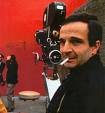
In the 1950's, Francois Truffaut advocated looking at film in a new way which became known as "Auteur Theory". According to Wikipedia:

"The auteur theory holds that a film, or an entire body of work, by a director (or, less commonly, a producer) reflects the personal vision and preoccupations of that director, as if she or he were the work's primary "author" (auteur).

"Truffaut's theory maintains that all good directors (and many bad ones) have such a distinctive style or consistent theme that their influence is unmistakable in the body of their work."


For a time, auteur theory was of interest only to academics and intellectuals, while ordinary filmgoers could care less about who the director of a film was. Your grandparents probably never talked about seeing the latest Billy Wilder movie (though they might have been aware of the latest Alfred Hitchcock movie.) Still, public awareness of the role of directors became widespread through movie critics who promoted the latest foreign film directors (including Truffaut), and in the 1980's the earth cracked open when names like Stephen Spielberg and Martin Scorcese became part of our daily vocabulary.

It seems as though we are coming in to a time when game designers are beginning to have the same visibility that film directors began to have thirty years ago. As in the 1970's, the talk is mostly among devotees, and mostly about Europeans. As once film had it's Truffaut, Bergman and Fassbinder, today boardgaming has its Teuber, Kramer and Knizia. Once there was a reawakened appreciation of Howard Hawks and today we rediscover the groundbreaking work of Sid Sackson.

Before we elevate game designers from being artisans to being auteurs we ought to ask: does this comparison really make sense? Is there really a basis in comparing games to films, music or literature? Can one really look at the body of work of a game designer and make out a distinctive style or consistent theme? To the extent that it is possible - is it of any consequence?

I didn't initially set out to write an article that questioned the value of examining the collected works of game designers. I set out to find a game designer whose body of work I could analyze, hoping to create a series around this. I soon hit a wall. It is difficult to identify a meaningfully consistent style in most designers. Even Reiner Knizia, who tended to create perfect efficient miniatures early in his career with games such as "Medici", "Modern Art", and "Tutankamen", soon moved on to create sprawling (by Eurogame standards) games such as "Euphrates & Tigris" and "Stephensons Rocket", which seem to have sprung out of an entirely different mind.

Then there is the question of what merit there is in the exercise. Take Rudiger Dorn. We could look at his three best games and indeed see a pattern. In "Traders of Genoa", "Goa", and "Louis XIV", Dorn uses a common mechanism to limit the choices that a player has. In each case, choices are laid out on an orthogonal board and players place markers on locations along a path (Call it the "poop dropping" mechanism). It's a nifty way to structure player choices, and best of all, it's a pattern! We've successfully applied auteur theory to game design!

Okay, so let's compare that observation with one that film critic Peter Rainer makes about director Brian De Palma in a recent Los Angeles Times essay.

"Despite the super-sophistication of his technique, in essence De Palma's movies express, at least for men in the audience, how sex was experienced as an adolescent. ... They capture the rage and mortification, the guilt, the tingle of voyeurism.

"One of the most unnerving things about De Palma's films, even more than their eruptive, gargoyle terror, is the suggestion that these adolescent anxieties are naggingly ever-present. The tyranny of sexual desire, woman as the Other — for most men, these fears still fly."

In contrast with Rainer's observations about Brian De Palma as an auteur, our own observations about Rudiger Dorn seem pretty lame.

The comparison, you might say, is unfair. A movie has a story; it has characters. It is meant to express something - whether it is the wonders of childhood, the anxieties of adolescence, or the alienation of adulthood. A game can't be expected to do all that or any of that. After all, it's just... a game. It's just a bunch of mechanisms.

Perhaps a game designer may not be able to express anything of consequence through his mechanisms, but what about his choice of theme?

The importance of theme no doubt varies across designers. Generally, being a game designer is a poor choice of occupation if theme is your intended means of expression.

Martin Wallace has chosen to maintain a high level of control in his games. He publishes mostly through companies such as Winsome and Warfrog, which he has close relations with, and which have either published his games directly or through licenses with companies that do not change his games. His game mechanisms tend to be closely related to the themes in his games. In a game such as Struggle of Empires, Wallace has chosen to express his thoughts on the drivers behind imperialism, and these thoughts are very clear in the game play.


Most designers, however, find their themes to be controlled at the whim of publishers. Alan Moon and Richard Borg created a game which aimed to capture the spirit of combat in feudal Japan. By the time it was presented by Goldsieber as Wongar, the game was changed by its publisher to be about aboriginal Australian rituals!

In an interview in The Game Table, Reiner Knizia spoke of the relative lack of importance that theme has for for German publishers.

"In America, the theme is seen as the game where as in the European the game mechanics and the game system are seen as the game." Knizia tells a story about when he took a game prototype to America. It had an Egyptian theme and when an American publisher saw the theme they said, "We are not interested in this game, we have a game about Egypt and we don't need another." ... A few weeks later he ... showed the same game to a German publisher. "Oh, we are just in preparation of an Egyptian-themed game, so the Egyptian theme wouldn't work for us. But let's see the game first and then we can see what we'll do about the theme."

Imagine Mark Twain's editor reviewing "The Adventures of Huckleberry Finn" and telling him: "We loved the book and we'd like to publish it. We've kept the basic story about a trip down a river on a raft, only now we've set it in China, and it's about a spice trader who leaves his company to join a local man on a search for a ruby studded statue of Buddha that can make them both rich."

Twain would probably have taken up another profession - something more honest and less prone to meddling, like accounting. Game designers carry on, unfazed.

So if a game's mechanisms don't express anything meaningful, and a game designer can't even control the theme of his game, what is left?

Reiner Knizia does believe that a game designer expresses his personal vision through his work. In his interview for The Game Table, he says:

"I think that every designer has his own handwriting. I am a scientist and that influences my character and how I see the world. So maybe my games have more of the analytical side stressed, not because I am doing this in awareness but more because that's who I am and that's how my world looks like. My approach is that the game should have very simple rules and depth of play comes out of these simple and unified rules. "

Knizia describes here not just a sort of mechanism, or a technique, but rather a guiding philosophy that indeed does reflect his personal vision. I emphasize the word "personal". Why should the rules be simple and unified? Do they make for a better game? Knizia offers no explanation, nor need he offer one. These principles are simply an expression of his personality.

A game with many rules designed to encourage players to explore the nooks and crannies in its mechanisms can be an excellent game - but it would not likely be a Knizia game. Reiner Knizia would of course never have invented a game like "Age of Renaissance", but I think that even "Power Grid" would have looked very different if designed by Knizia. Power Grid has relatively involved rules concerning the changes that occur every time the game enters a new "Phase"as the power plant market gets manipulated and supplies of commodities change. Specific rules create handicaps for leading players. Power Grid has been approached like a work of engineering in which a mechanism may be added to solve a specific problem. Knizia describes himself as a scientist - which along with his stated approach to game design implies that he believes function is more of a consequence of natural laws than an active attempt to manipulate them.

Game designers become auteurs when their style reflects not just a frequently used mechanism but rather an entire approach to gaming, and implies what they believe a game ought to be. In the case of Knizia the scientist, games manifest the complex possibilities that emerge from relatively simple natural laws. If Reiner Knizia - the game designer - is indeed a scientist, he is probably a physicist.


The games of Bruno Faidutti have sometimes been criticized for having too many chance and chaotic elements in them. I imagine his response would be: "guilty, proud of it." Faidutti seems to revel in unpredictibility, and wants his players to share in the fun. He pretty much declared his attitude to the world in one of his earliest published designs: "Knightmare Chess". That game starts with the great Western classic game, but gives players cards which allow them to muck around with the rules in unpredictible ways.

To add unpredictibility to chess is a little like painting a mustache on the Mona Lisa. It takes a certain kind of person to do that. More than anything, it tells you a little about what his idea of "fun" is.

In "Citadels", Faidutti's most successful and celebrated game, players target each other with their special powers but in a highly unpredictible way. For example, a player who has taken the role of the "thief" can choose a character whom he plans to rob - but can only make a hunch as to which player he is actually robbing because players choose their characters secretly. This can lead to a lot of grumbling both from the thief, who may have targeted a player who has nothing to steal, and especially from a player who was trailing and became the unintended target (and especially when I'm that player!).

Faidutti's games are often described as being "chaotic" and it's rarely intended as a compliment. The pattern in his games are however so unmistakable that it is clear that Bruno Faidutti revels in the chaos, builds it into the games intentionally, and regards unpredictibility as an essential part of the fun in gaming. I think that the only way to properly appreciate many of his games is to play them in the spirit intended - partly as a battle of wits, but equally as a wild ride. Climb onto the bull and hold on!

This attitude toward finding the fun in a game can manifest itself even into the simplest things - like whether a card game should have a player draw his card before or after his turn. On his website, Faidutti describes the difference:

"The 'draw a card, then play a card' rule ... strengthens the surprise and fun aspect of the game, to the detriment of deep thought and strategy. During opponents’ turns, one will try to think of what one will do next, but will also day-dream of the card one could draw when one’s turn comes. This card, when drawn, may cause some impulsive reaction, and may be sometimes a bad move – but that’s an important part of the game fun. The 'play a card, then draw a card' rule emphasizes on strategic planning. It means one can think of all the possible moves, and check their possible effects, before one’s turn comes. "

From everything we've seen about Bruno Faidutti so far, his preference should be no surprise:

"(Play a card, draw a card) sure makes the game deeper and more challenging, but it also makes it feel less fun and less natural."

Reiner Knizia and Bruno Faidutti are two of the most stylistically assertive auteurs in the game world. You may or may not like their games, but the reasoning behind your opinion is likely to be closely related to the difference between what you find to be fun and what each designer believes to be so. This strong design philosophy is what separates game auteurs from journeymen whose designs lack personal style.

It is really a strong design philosophy and not particular mechanics that define the auteur. When evaluating a designer, the interesting question is: "What effect does he want to achieve?" and not "What technique does he tend to rely on?"

Compare Alan Moon and the team of Wolfgang Kramer and Michael Kiesling. In many of Alan Moon's games, players draw cards from a face-up selection (Elfenland, Union Pacific, Ticket to Ride). Often players are given from one to three actions in a turn (draw cards or use cards in both Union Pacific and Ticket to Ride, the limited actions in Reibach/Get the Goods or Andromeda). On the other hand, Kramer & Kiesling have frequently used action point mechanisms where players get from 6-10 AP in a turn with myriad possibilities on how to spend them (Torres, Tikal, Java, Mexica, Bison). The obvious reason that each designer tends to reuse his mechanisms is that the mechanism works, is reliable, and is flexible enough to solve certain design problems in many games.

Apart from that, each technique reflects a different philosophy. By presenting users with three or four card choices, Alan Moon is pushing some unpredictibility into the lap of his players and forcing them to choose between some very limited options. The chance and unpredictibility of the choices forces the user to adapt to the unexpected, and those key basic alternatives ("play a card or draw a card?" are the essence of the "Agonizing Decision". In contrast, Kramer & Kiesling prefer to be far more open ended. Their gamers' games challenge a player by dumping a large quantity of resources into his lap, presenting him with decision trees that have an intricate network of branches, and demand that the player builds a strategy which uses these resources most effectively.

Alan Moon seems to see the greatest joy in gaming as confronting hard decisions. Kramer and Kiesling see the joy come from the challenge of managing resources and exploiting opportunities.
That pattern has more meaning if it can be applied to other games which don't use the same mechanisms as card drafts or action points. For example, in San Marco, Alan Moon gives players limited hard decisions - but with an entirely different mechanism. He gives one player a series of selected action cards and challenges him to divide them into stacks which his opponents may choose from. Then he gives the remaining players the very limited - but no less agonizing - responsibility to choose the one stack with the most useful actions and least painful penalties.

When Wolfgang Kramer created "Hacienda", he used a card drafting mechanism similar to that found in games such as "Union Pacific" and Ticket to Ride, but he puts these cards to a much more open ended use than is typically seen in Alan Moon's games. In Moon's "Union Pacific" the cards a player draws are fairly passive assets. You draw them, you play them in front of you, and hopefully you score with them. Even in "Ticket to Ride", players have very specific paths that they are trying to take, and they draw cards they need in order to complete those paths. The tension comes from deciding when to draw, when to play, and from dealing with the need to make detours. It is usually self evident where a particular set of cards needs to be placed for a player to achieve his goals. On the other hand, the cards in Hacienda are open ended resources which can often be placed in many different places. Having a set of any cards is just the beginning of the challenge to the player who needs to construct a plan on how to use them most effectively.

Two designers take a similar mechanism - a multiple choice card draft - but treat the use of the cards in entirely different ways. Each use reflects what its respective designer regards to be the interesting challenge in a game.

How, then, are we to interpret games such as Kramer's "That's Life", a family game which offers players very limited choices? How does such a simple game fit in as a part of the designer's stylistic signature? I think that the most honest answer is: "it doesn't." Game designers, especially professionals, need to develop a large number of games every year to be economically viable. All of them will to some degree reflect the designer's values, but many will still be journeymen games that are principally created just to meet the needs of publishers and the public.

Another reason a designer may venture outside his style is just to experiment and mix it up a little. So from Reiner Knizia we'll see a game like "Blue Moon", which has lots of different cards with different powers, and seems a little elaborate for a Knizia game (although its rules are, true to form, very simple.) It seemed very out-of-character when Bruno Faidutti worked on the redevelopment of "Warrior Knights", a long and relatively complex war game, but there it is. Of course, sometimes experimentation is also a way of moving on to something new permanently. We may never again see Reiner Knizia offer up more minimalist masterpieces in the mold of "Modern Art" and "Medici" again (I swear - that run of "M's" was NOT intentional!).

Finally, sometimes an auteur's fingerprints may be a little hidden. The task of decoding and understanding the art of game designers is in its infancy, and in time, as the hobby grows and more people become fascinated with this issue, new minds will discover patterns that are overlooked today. "Stephensons' Rocket" is often regarded as uncharacteristically involved for a Reiner Knizia game. Yet it has only four pages of rules and takes about thirty paragraphs to explain. Compare that with Kramer and Kiesling's "Mexica", which was described as "family friendly" when it came out, and yet has ten pages of rules and about ninety paragraphs. Knizia really does stick to his word when he talks of creating games with "simple and unified rules" even when he slips to the complex side of the spectrum. Switching to film again, there may have been a time when it seemed only coincidental that movies such as "Sunset Boulevard", "Some Like It Hot" and "The Apartment" sprung from the same mind, that of Billy Wilder, but in time admirers have come to see the sexual cynicism that unites them all.

Indeed there is a Catch-22 that impedes our ability to comfortably see the auteur behind the game designer. In order for a designer to really establish his stylistic handwriting, he needs to design and publish many games. But any designer who does so must increasingly design some of his games for purely economic reasons, to satisfy the tastes of a large public audience. Those tastes may or may not coincide with what especially interests the designer.

Some of the most highly rated games to have been published in recent years are not from the great well-established auteurs we've mentioned above, but instead are games from new designers with little or no track record which we can examine for trends. What will the fifth, sixth or tenth game by William Attia, designer of Caylus, be like? Future games will hold new secrets to unlock. Some designers will develop strong styles in their games, while others may produce excellent games but without developing a strong personal style. For many of us players, the joy comes not only from the playing but also from the appreciation of the person behind the game.

Monday, September 25, 2006

The Well Constructed Game

Printable Version


Some board games seem constructed like a Mercedes and some seem contructed like a Yugo. Some games respond actively to every touch of the pedal and hug the road on every twist of the wheel, while some have trouble shifting and then bang around noisily from all the loose connections.

In game terms I mean that some games have all of their mechanisms tightly tuned, where every rule presents an agonizing decision, and every decision affects your game, while some games are thrown together, with rules that hardly matter and frequent decisions that are barely relevant.

Even if the latter game "basically works" it lacks the thrill of the feeling you get when a game has been trimmed and tuned. That's what The Well Constructed Game is: one which is not only fun, but which has all of its mechanisms tied together, effective, and purposeful. In this sense, The Well Constructed Game truly is a work of art - it has an aesthetic thrill that goes beyond its basic function of entertainment and competition. This artistry is very difficult to pull off and is the mark of a great designer.

I want to talk here about compactness and elegance in a game design - deliberately avoiding what neccessarily makes it "fun". In admiring The Well Constructed Game, I don't want to imply that this characteristic is either neccessary nor sufficient for a game to be good. But we can certainly admire it when we see it.

For much of his early career, Reiner Knizia was especially admired for how much good game he got out of some incredibly simple designs. Modern Art is a terrific example of a very simple and Well Constructed Game from this era. The basic structure of the game requires players to maximize their income both when they sell works of art (cards) to other players, and then later when they sell the art back to the bank. What drives the game so wonderfully is the scoring mechanism which creates a spectrum of implications for the players. Basically, the cards auctioned off come in one of five suits ("artists"), and the artist whose works have been most auctioned in that round pays the most. Players therefore have motivations to promote the auction of artists whose cards they hold in their hands - knowing that this will make them fetch a higher price - and they have motivation to auction off cards by artists they've already bought in the round - thereby bolstering their value at pay off time. Additionally, Knizia incorporates an excellent scoring bomb by having the values of paintings accumulate each turn - but still paying zero if that artist isn't in one of the top three positions. With just an auction and a well designed scoring mechanism, Knizia creates a very tense and engaging game. Every element in the scoring mechanism has a way of working to create strategic decisions for the players.

Actually, one could fairly argue that there is a supefluous mechanism in the game. There are 4 different ways that a card may be auctioned, and each card specifies how that card is auctioned. It might be through an open outcry, or a closed bid auction for example. These alternatives definitely add color to the game, but are they neccessary? I think that they're a little fiddly, and they detract from the game's basic elegance - but I love 'em anyway. I suppose that this shows that being Well Constructed is a nice thing - but it's not everything.

The Well Constructed Game is efficient but it need not be simple. It is not important that there are very few rules - only that every rule contributes significantly to the game play. Wolfgang Kramer and Richard Ulrich created a miraculous design in "El Grande". In El Grande, players place wooden cubes from their "court" supply onto any of nine regions on the board, in an attempt to get first, second or third place leadership positions during the game's three scoring rounds. Essentially, three mechanisms drive the game, and each one is a doozy. The first is that players must bid for turn order in each turn- which is key because early players have their choice of "Action Cards" which can give great advantages. Gnashing against this, is the fact that the higher your bid to go first in the round, the fewer "caballeros" (wood cubes) you'll have in your supply to place on the board. Finally - Kramer and Ulrich create an extremely effective tool to govern where players may place their cubes at any moment - they must be into a region adjacent to the "king", but not in the same region as the king itself. Moreover, the king is moved each turn - with the right to control his placement governed by the player who earlier bid for that right. As anyone who has played El Grande knows, this simple rule governing the king and his placement creates a spectrum of tactical decisions for the players.

Notice also how these three mechanisms mesh with each other. You want to control the king to place your caballeros in the best position. To do that, you need to bid high for that right. But the higher you bid, the fewer caballeros you make available to yourself. The interaction of its mechanisms, the dramatic effect each mechanism has on game play, and the agonizing decisions they place on players all combine to make El Grande a supremely Well Constructed Game.

I first noticed the value of a Well Constructed Game when I was playing a game I found to be poorly constructed: the self-published Garden Competition by Ken Stevens. Garden Competition is by no means a bad game, but what struck me was just how many different rules and mechanisms seemed to not achieve their intended effect. For example, a key aspect of the game is the fact that players must decide which flowers to plant. Of the dozen or so different types, only certain ones are worth points at the end of the game. There is an elaborate system in which each player has slightly different information on which flowers - or colors of flowers - will score. Players are expected to deduce which flowers are valuable by observing their opponent's behavior. The problem is that deduction is either trivial or unneeded. If an opponent plants a rose, it means either "red" or "rose" is worth points. If you can get a rose - plant it. If not... well then there are so many *other* flowers to focus on, you may as well just ignore it.

This looseness and clutteredness in design shows up in the work of seasoned designers as well. If a Well Constructed Game is one with no excess baggage, then it's easier to appreciate tight design by looking at games by otherwise excellent and respected designers that seem burdened by superfluous mechanisms and inconsequential game play. Oasis by Alan Moon and Aaron Weisblum and Keythedral by Richard Breese are examples of designs with rules and mechanisms that have a disproportionately low consequence on game play and strategy.

Oasis is an unfortunate example of a boardgame where nothing that happens on the board is all that interesting. Players collect tiles in 3 different land types, trying to gain large clusters of adjacent tiles. But unlike a similar mechanism in Merchants of Amsterdam by Reiner Knizia, it is rare to find oneself threatened with being cut off or enclosed. Oasis tends tco have fairly large areas to play one's tiles, and there are no tactical objectives besides getting a lot of them all together. In contrast, Merchants of Amsterdam requires players to lay adjacent clusters of tiles in the sections of the city, but the grid is narrow (2xn), and littered with strategic points (bridges) which encourage players to play tiles where they otherwise wouldn't want to. The effect in Oasis is a feeling of pointlessness and disappointment. Here is this evocative board with placement rules and the promise of interesting strategy. Eventually players find that their choices aren't all that important, that it is unlikely that they will be cramped in, and that the feeling of tension was false.

In no way does this break the game. It remains entirely playable. But by having its board not finely tuned, the game ends up feeling a little limp and disappointing. Players have a sense of putting tiles on the board for little purpose.

Keythedral suffers from the problem of having needless distinctions for its commodities. Keythedral is a little like Settlers of Catan in the way that players collect five different types of resources by having cottages and workers on tiles which produce goods each turn. Collecting certain combinations are important at the beginning of the game in order your upgrade cottage or to build fences which help you defensively. However, soon into the game the primary use of resources is to spend them in particular combinations in order to buy tiles which are worth victory points. As the game progresses, larger quantities of resources are needed to buy bigger tiles worth even more VP's.

Pretty cool until you start to realize that this entire mechanism barely matters. There are so many tiles that will come available in so many different combinations that any player has no urgency to take any particular resource type. Nor is there much need to rush to take that perfect tile when it comes up. If you just hold on, you'll find the tile you need for whatever resource cubes you have. (A limit on the number of cubes you can hold would have been effective.) Furthermore, the amount of VP's you get per cube doesn't really change throughout the game. Early on you get few VP's for few cubes, and later you get lots of VP's for lots of cubes - but the value is pretty much proportional. There is neither much incentive to spend your cubes early nor to save them for later. What seems to be a series of tactical choices for the players aren't really choices at all because they hardly make any difference. Only in the last game turn or two, when future VP tiles become limited, does the urgency to manage your purchases become tense - and suddenly the game picks up a little.

Compare this to the William Attia game Caylus, which also uses different types of commodity cubes, but far more effectively. In Caylus, players have many different uses for their commodities - to buy tiles, to help construct the castle, or for special features such as the "joust". In fact, commodity cubes used in the castle have great flexibility as well: the only restriction is that of three cubes, one is "food" and that all three cubes are different colors. With such flexibility, you would expect that players would be unconcerned about which particular color of cube they pick up. In fact, the distinction among colors works extremely well. For one thing, although castles tend to need food, jousts need cloth, and tiles are hungry for wood and stone, each choice has different strategic implications. So while a player may almost always be able to find a use for his cubes, he needs to manage his production in order to achieve the particular strategic goals he has set for himself. Furthermore, any of these uses - tiles, castle, or joust - can't be chosen at will. The ability to joust or to build tiles is in short supply for each turn, and there are tactical reasons that a player may want to contribute to the castle ALOT on this turn, but not at all on the next turn. Finally, while a player who gets shut out of his choices can always accumulate cubes for another day, timing is much more important in Caylus than it is in Keythedral. A tile built this turn has greater opportunity to earn VP's. The need to delay a castle contribution can mean missing out on getting a bonus or stealing the majority favor from another player. In practice, players find that they need to plan carefully to take and spend the right combinations of cubes - and they need to desperately create alternative plans when their original plan doesn't go as expected.

The one thing that holds me back from calling Caylus a Well Constructed Game is that annoying matter of the unbalanced favor table. In Caylus, a player will occasionally earn "favors" and he has a choice of four different types to take. Of these, one type (commodity cubes) seems so weak that players hardly ever pick it, and one (money) is sufficiently underpowered that players typically use it only as a fall back or occasional choice. How much tighter and more satisfying the game would have been had each favor created its own strategic path! Fortunately, this doesn't hurt the game that much. You can always ignore those paths and they are not a major part of the game. This is very different from the case with Oasis where players must use the board constantly only to feel that they are spinning their wheels whenever they do so.

I am not a board game designer, but my belief is that playtesting is the most important contribution to a Well Constructed Game. Designers need to brainstorm. They need to come up with lots of creative ideas, and in many cases, there is little way to distinguish between what is working and what is superfluous without seeing the mechanism in action. Is the board too big to force players into Agonizing Decisions? How often are people using all the options presented to them (and how often do they win with the less popular ones?) When I wrote my series of Game Theory 101 articles for The Games Journal, all of the ideas I had were addititve in nature. What do designers put in a game that cause its complexion to change and create a Story Arc? Where are the bombs that place players in do-or-die situations? What conditions can be imposed to force players to constantly reevaluate their positions? The Well Constructed Game is the product of a reductive process. What stuff was added to the game that isn't making a difference? What decisions aren't agonizing - and can they simply be eliminated?

I've spoken here about the value of a game having no superfluous elements. Of course, a game succeeds on the basis of what it does have and not what it doesn't have. So appreciating a Well Constructed Game is mostly a matter of aesthetics. It is an opportunity for us game-lovers to simply admire the perfection in a board game design above and beyond the hours we spend immersed playing it.

This is what I am hoping to achieve in this journal with every article. A greater pleasure in the love of The Game.