Printer friendly
In the introduction to this blog, I state that what I really care about in a game is its mechanisms, not its theme. And that's true. To a point. Some popular Eurogame themes tell you nothing about the mechanisms involved: Ancient Egypt, Renaissance Italy, Pirates. There are some themes, though, that do imply
something about the mechanism involved. Offhand, these include racing games, railroad games, and business games.
Business games are my personal favorite genre. It's a natural for me, since my graduate degree is in finance, and my career is in business planning. I like the idea of building things that make money, and reinvesting the proceeds to build even larger things that make even more money. I prefer the challenge of competition to that of conquest - and so I prefer my escapades to come from playing a business game rather than an empire building game.
But not all business games are about economic development in the way I described. Some, like
Chinatown, are about trading. Some are about buying and selling at a profit. This would include many "Pick up and deliver" games like Eurorails, as well as speculation games such as "
Buy Low, Sell High", and operational business games like
Schoko & Co.
But what really gets my juices flowing is the idea of building a commercial empire - investing in capital, reaping the profits, and reinvesting. This doesn't truly even need to take the form of a "business" game. It can have any darned theme. I'm going to call these "economic development" games, and I'd like to pull a few of my favorites apart to see what makes them work.
The games I'm going to examine are, in many respects quite different from one another.
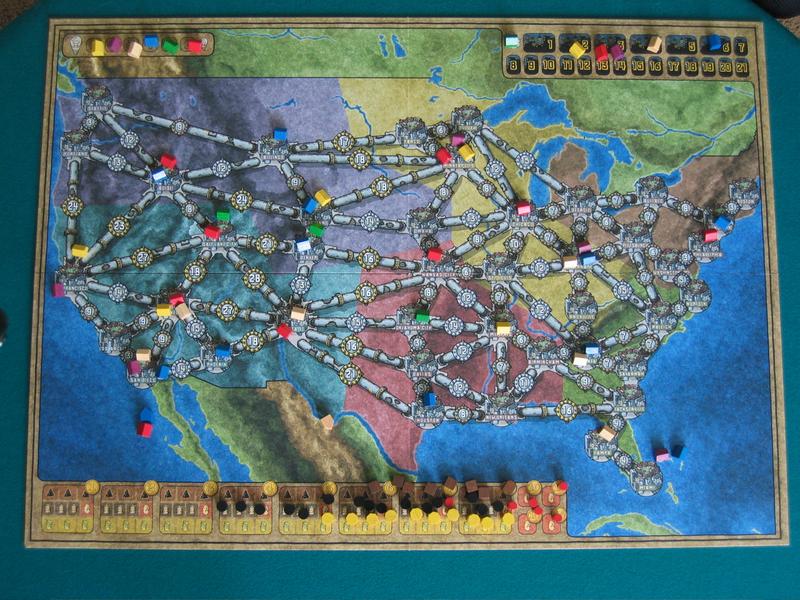
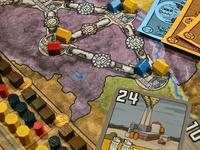
Power Grid, by Friedmann Friese, is probably the most obvious and pure form of this genre. It's modern. It's literally about business.
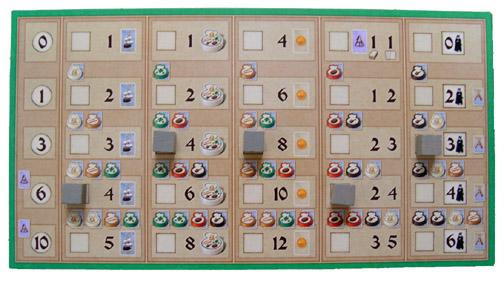
Goa, by Rudiger Dorn is themed as more of a trading game, but players don't trade with each other or with the environment in any real sense. The heart of the game is gaining resources - spices, ships, and money - and reinvesting them in a way that increases your future output.
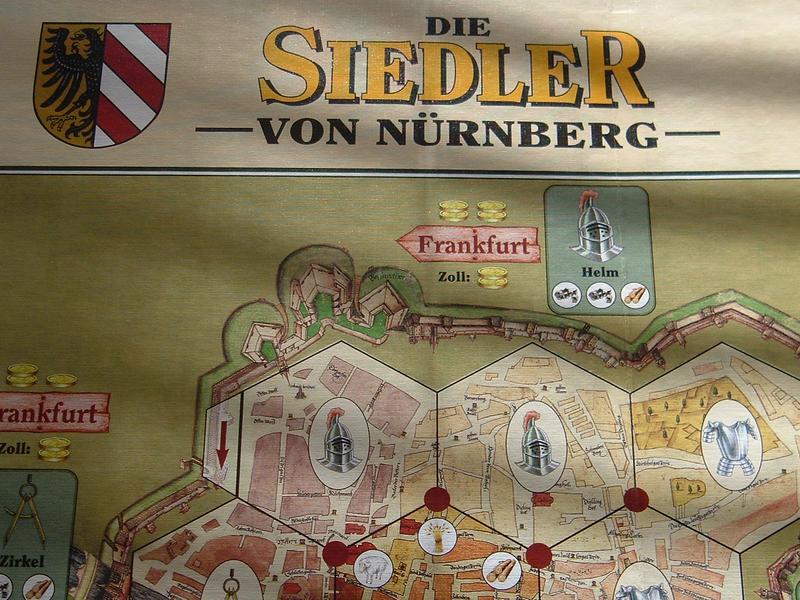
Settlers of Catan , by Klaus Teuber, is themed as more of a community building game, but it is a game of economic development in the truest sense. Finally,
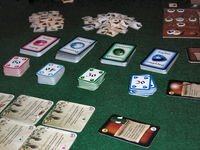
The Scepter of Zavandor , by Jens Droegemueller, avoids the theme of economics entirely and instead cloaks itself as a fantasy game of collecting magical gems - but who's kidding whom? The game is adapted from the Sci-Fi economic development game, James Hlavaty's
Outpost, and plays like a business game. Zavandor is familiar to the fewest readers, so I'll explain its mechanics, later, in more detail. It is expected to be released in an English language edition later in 2006.
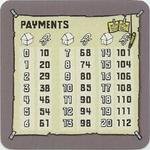
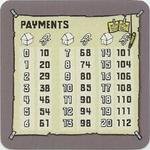
By my own standards, games of economic development come handicapped. They tend not to involve majority control, and so it is more difficult to create "bombs" that provide disproportionate rewards. Indeed, by their nature, they tend to be rather incremental. In the case of Power Grid, the rewards for maintaining larger systems are actually *less* than proportional. For example a size "4" grid pays off 46, whereas a size "8" grid pays off 74 - less than double. So one challenge in making such a game successful is in creating that "do or die" tension in other ways.
Conversely, another pitfall is in avoiding the runaway leader problem. Economic development games can be low on player interaction. If four players are each building up their empires independently, without getting in each other's hair, how can a player in fourth place ever hope to catch up with the leader? The leader presumably has all the advantages - not only more money (perhaps) but also a superior infrastructure that guarantees him the future advantages.
Finally, these games may or may not suffer from a lack of Story Arc. If all a player is doing is building, reaping rewards, and reinvesting - there is a danger that the end of the game may feel exactly like the beginning of the game - only bigger. There needs to be something that causes game play to turn a corner and become slightly different in character as it proceeds.
Some of the games I've mentioned have these problems. Some deal with them well; others not so well. But I love 'em all. I don't think it's quite like the case of the French chef who has a hankering for Big Macs. Rather, I think that these games have some other things that make them special - and I'm hoping to examine and discover that. In the process we'll look at some of the problems and mechanisms they share and how each game approaches them.
The basic mechanism in any of these games is that players control assets which will periodically pay off, and then have those proceeds reinvested. The basic challenge is in keeping this from being totally generic - like a bank account that just pays interest. What's the catch? Where's the competition? What wrinkles create
agonizing decisions for the players?
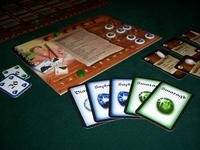
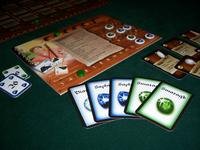
Scepter of Zavandor is probably the most straightforward of all the four games in its mechanisms. There is only one currency/commodity: "energy". There are five different types of gems (read: factories) that produce "energy" (money), but each one is just like the others only bigger. So sapphires produce about 5 units a turn, emeralds about 7.5, diamonds about 10, and rubies about 15. Players earn magic each turn, and then reinvest it in more gems and bigger gems, gradually increasing their production each turn. So far, it sounds like about as much fun as investing in certificates of deposit. The key wrinkle here is that players face severe limits to growth. They may only have up to five gems producing on any turn, and they may buy nothing bigger than a sapphire. Maximum production: about 25 magic units a turn. There are, however, three ways around that:
1) Get more spaces to put gems
2) Get the right to buy bigger and better gems
3) Get special cards that act like bigger gems, but require no spaces.
The most critical strategic decision players face is in how to break through the glass ceiling that limits their production. Each of the approaches above has, in turn, different ways to go about it. The right to buy emeralds and diamonds come from cards that are in short supply, which are expensive and must be purchased at auction. The right to buy rubies, on the other hand, is a special power which requires long term investment which is in itself expensive, and which doesn't pay off for up to four turns. While it's certainly possible to develop a plan that enables you to buy all types of gems, such a plan is expensive and redundant. At what point do you skip a level - and for how long can you tolerate producing at a suboptimal rate?
Similarly, there are alternative ways to get more spaces to put your gems - also limited and expensive. Which is the best path and when do you switch over? More gems? Or bigger better ones? Or both?
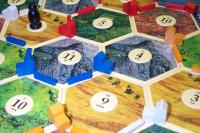
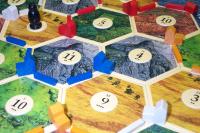
Settlers of Catan turns out to use this mechanism as well - although it shows up in a very different way. In Settlers, players are also confronted with the alternative of building bigger production facilities, in the form of cities, or more of them. As in Zavandor, the additional challenge of being able to build more production facilities is finding the place to put them - by building roads and expanding your network. Both games provide players with scarce resources and competition for these additional sites - although in Zavandor a player does have the ability to create up to two additional sites with no competition - by buying advances. I think that the race for spaces on the board in Settlers is the more interesting challenge - precisely because it is more competitive - but I do admit that in Zavandor, a player does face some agonizing decisions in the choice of which of the six advances to purchase in any given turn. Each of them is, in its own way, so important - and you can only buy one per turn!
Power Grid makes the question of expansion intriguing by
not permitting players to grow the number of sites they have. Players may own 3 power plants at any given time, and can never grow beyond that. Any further plants must displace one already owned. By cutting off one avenue of growth, designer Friedemann Friese creates a distinct strategic dilemma.
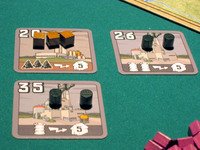
"To what degree is this new plant even worth owning? It's expensive. If I don't buy it, I'm limiting my growth until a newer better one becomes available. But if I do buy it, there is an (often severe) opportunity cost of possibly having to let it become obsolete at a later turn, and passing up a more attractive plant that could show up in a turn or two." For me, the choices around which power plant to buy, and when, and how much to pay are the most appealing aspects of Power Grid. It is a great example of how lopping off certain player choices can make what's left so much more challenging. If players were able to own any number of power plants, each one would, to a greater degree, just be scaled up versions of one another. A plant that fires up 4 cities could be directly compared to a similar one that fires up 2 cities - after adjusting for the cost of fuel. But in Power Grid, that's not the case. The smaller plant will prevent you from reaching victory conditions, which require you to fire up a certain number of cities using only three power plants. It has built in obsolescence which must be considered.
The limitation on the number of plants in Power Grid helps to prevent them from being perfectly scalable. If they were, then their values could be more objectively calculated, and the whole game would be less interesting. The productive ability of the different gems in Scepter of Zavandor is scalable - but while it is possible to either get better gems, or more places to put them, each option has a cost, and this cost helps make the game resist analysis and keep it interesting. In Settlers, production has only limited scalability (you can't grow past a city), and the fact that turning settlements into cities requires entirely different resources than does building roads and new settlements gives the tradeoff its own unique characteristics. So does the fact that expanding your network of roads has it's own challenges. But all three games offer the same basic challenges to the players: how do you grow your production network when there are both limits to the size of the "factories" and limits on the quantity that you may own.
Some games of economic development rely on one basic type of currency which is produced and spent, and others use distinct commodities that need to be collected, managed, and combined. Again, Zavandor is clearly the most straightforward: everything is measured in "energy", and the only difference among the gems is how much of it they produce in a turn. Although Power Grid involves different types of fuel for energy, your network produces money and requires money to fund it. The different types of fuel are all comparable - and the only real difference between them is the fact that some will be more expensive and some will be cheaper (although shortages can also play a role sometimes.)
Settlers of Catan was a groundbreaking game in the way it uses

five different commodities, combined in different ways, for a player to reinvest and build his production abilities. Settlers was not strictly the first game in which players produced different commodities. Other games, however, could not come up with a way to use this differentiation effectively, especially for economic development. Pick up and deliver games such as the "
Empire Builder" series, by Darwin Bromley and Bill Fawcett, just used different commodities as a way to determine which cities could deliver to which other cities. In 1977 SPI published "
After the Holocaust" by Redmond Simonson and Terry Hardy, a game of economic development, which mostly just required players to build their capacities up equally in each commodity. It packed a lot of rules into mechanics which were ultimately less detailed than those found in Settlers of Catan (but, for example, required much calculation any time a player wished to consummate a trade).
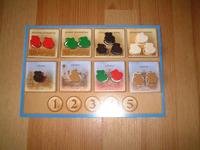
Goa also uses the feature of different commodities, but in a manner that creates very different consequences for game play. In Goa, the ability to improve your production in any of five categories requires the expenditure of an equal combination of "ships" and "spices". The ships come in one flavor (uh... "ships") , but the spices come in five flavors (ginger, cinnamon, pepper, nutmeg, cloves). Regardless of the production track you are trying to improve, going from a level "1" to a level "2", eg, will require two ships and two spices - but the specific spices needed will vary. And I really mean vary. As the game unfolds, the particular spices that a player needs will be constantly shifting. What makes this especially challenging is that unlike in Settlers, there are "no substitutions". Players cannot trade and they cannot substitute multiple copies of one spice for another. The only flexibility a player has is that some of his plantations are wild cards and can produce any type of spice. Players will typically be strong in producing certain spices and weak in others.
The limited flexibility in the use of differing commodities in Settlers and in Goa ends up causing that mechanic to have entirely different game consequences. In Settlers, a player may be somewhat neutral in the decision to build a settlement or a city at any given moment ("it's all good"). In Goa, the order of building is extremely important - every action depends on the prior ones.
Moreover, in Goa much more than in Settlers, a player has very specific plans which he is trying to execute in a specific order. Rudiger Dorn has used the differentiation of the spices to limit each player's options and thereby force them to develop long term plans. He uses the unpredictibility of the auctions for tiles to muck those plans up a little - presenting unexpected opportunities. The tightness of the need to get ships and specific spices, along with the unpredictibility of the auction phase injects a
Nervous System into the game which forces players to constantly reevaluate their plans. In this sense, Goa has a lot in common with
Princes of Florence. Both are games of intense planning where very specific assets need to be acquired, often in a specific order, for a player to maximize his score. Perhaps it is no coincidence that both games alternate fairly controlled purchase phases with more chaotic auction phases to work so effectively.
What we see is that designers use differentiation of commodities in differing doses to restrict a player's options, make a game more "gamey", and require more planning. In Goa, the differing spices needed to build to new levels force a player to plan carefully and go down paths that are not the most direct ones to easy growth. Settlers of Catan doesn't require or permit the same degree of planning because of the luck involved in getting any given commodity, and because players may substitute commodities by trading with each other or at the ports. Scepter of Zavandor is even more business-y and less gamey because the primary production commodity is the fully fungible "energy". However, players are heavily restricted in their ability to purchase the more valuable gems that produce more energy, and so this differentiation creates obstacles to growth. In Power Grid, the need for differing types of fuel mostly just affects cost, and only occasionally will block a player's growth. Power Grid is the most realistic business game of the four and it has the fewest artificial restrictions that are introduced primarily to enhance game play.
One problem in any game in which players build a production empire is the potential for a runaway leader to emerge early on. In these sorts of games, if a player emerges as a leader, not only does he have more victory points, he also has superior assets with which to get even more victory points. So the argument goes that an early lead can be unstoppable and the game can be flawed or even broken.
As a general rule, this can be the case if the leader is able to mimic the moves of those players who trail him. If I have all the assets you have - and then some - then literally, anything you can do I can do better. And I will. So for a game in this genre to avoid breaking down, it has to insure that trailing players have options which the leader won't neccessarily have and which can be better than the ones he does have.
There is an obvious way to handle this problem. Unfortunately, it is also an unsatisfying way. That is, to just provide special bonuses to trailing players and handicaps to leading players. Two of the games we're looking at use this mechanism. In Scepter of Zavandor, players are able to acquire certain assets - artifacts (special power cards) and sentinels (bonus scoring tiles) more cheaply just by virtue of being a trailing player. Power Grid goes even further, providing benefits to trailing players and handicaps to leading players in nearly every phase of the game turn. In Power Grid, trailing players can buy fuel more cheaply, they get the jump on advancing into new cities, and they have much greater flexibility in putting up new power plants for auction and bidding on them. In fact, the benefits awarded to trailing players in Power Grid are so great that a key aspect to strategy in the game is knowing when to hang back, deliberately underperforming, in order to maintain a competitive edge on opponents.
For my money, handicapping is a cheap designer's trick that distorts the core game design. It's a cheap trick because it is an artificial add-on. It's really more of a remedy than a core game mechanism. Games, at their best, shouldn't need special rules to fix them. It is like selling a car with a flawed design that causes it to accellerate uncontrollably, and fixing it by putting a piece of wood under the gas pedal. Handicapping distorts the core game design because it encourages players to try to win by underperforming. This is a business game!
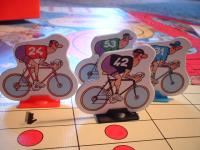
Show me a business executive who would rather be sixth in his market than first, and I'll show you someone on the way out. This is not the same as holding back in order to manage limited resources. Nor is it comparable to the situation in other game genres. In a racing game, it is reasonable for players to benefit by slipstreaming. But please leave those strategies to the next Lance Armstrong - not to the next Bill Gates. Bill Gates does not try to be #6 *in anything*.
I wouldn't deny that both Power Grid and Scepter of Zavandor could suffer from a runaway leader problem if it were not specificially remedied, however neither game is structurally guaranteed to prevent a trailing player from catching up. The key is that any trailing player
might have certain assets which would benefit him more in the endgame than they had up to any given point in the game. For example, in Zavandor, as we discussed, a player has many limits to growth: the size of gem he is capable of buying, the number of spaces he can use to activate gems. A leading player might have more gems that are providing a greater income, but the trailing player might have invested in assets which make it possible to expand more rapidly in the future.
It doesn't always - or often - happen that way, and so designer Jens Droegenmueller added the catch up rules to James Hlavaty's original "
Outpost" design. But there are other ways that designers have dealt with this - which may or may not have been appropriate to the game. For example, a key way of getting more gem spaces is by buying certain advances. These advances are available to everyone. Had they been in limited quantity, then a player might be faced with investing in them early on, knowing it will slow his growth, on the knowledge that it will help his endgame position. Indeed, keeping assets scarce is a general way that designers force players into tradeoffs such that the short term leader may not have the best long term position.
And of course, sometimes in a game, one player will have it all. He'll have more money, more production assets, and more growth potential. At best, a game should have been designed to make that an unlikely occurrence. But sometimes, there's been one player who has just cleaned up - in which case the best thing that the game can do is to have endgame rules that recognize it as soon as possible, declare him the winner, and put everyone else out of their misery.
To some degree, a game is only going to have a runaway leader problem if the leader can concoct a plan and follow it faithfully. Another factor will be if a game tends to have a single path to victory. After all, if there is only one way to victory, trailing players will pretty much have to follow in the leader's footsteps to advance. While there is a lot of good gaming in Power Grid and Scepter of Zavandor, it is true that there are limited ways for a trailing player to circumvent the leader without the built in handicaps. In Power Grid, a trailing player would need to have power plants that use differing fuel than the ones the leader uses - on the hope of saving enough money to more than compensate for the additional income that the leader is generating. Possibly he may be in a better position to enter cities more cheaply. But typically, a player that has fallen behind has no better access to cities nor resources, and any advantage that he may have can be minimal.
Both above games, not coincidentally, use single commodities, money and energy respectively, as their medium of exchange. This fact will tend to exacerbate a "single path to victory" situation and pave the way for a runaway leader.

Settlers of Catan has many tools to alleviate the problem. The most basic is luck. A trailing player just might get the die rolls he needs. Usually, though, by midgame, the influence of luck lessens because all players - especially the leader - have spread out to cover a greater variety of numbers. The "take that" mechanism of the robber can certainly slow the leader down. But in Settlers, there just tends to be more player interaction, and this is helped by the fact that the game uses five different commodities. In addition to encouraging the use of trade (which a leader can be frozen out of), the varying commodities and competing uses for them will tend to put players on differing paths. A leader may be strong in wood and bricks, helping him to build his network and develop settlements - but then become stuck when it comes to getting the wheat and ore required to build cities. The combination of luck, player interaction, and alternative paths and varying commodities puts the unpredictibility into the game which alleviates the runaway leader problem found in games of this sort.
Of course, in Settlers, you can still get totally boxed in and be a runaway loser. I never said the game was perfect.
Goa has so many different interacting mechanisms - including the use of multiple commodities - that the runaway leader problem tends to be alleviated here as well. (Or possibly, the game is so complex and players are so focused on their own player boards that nobody notices.) There is no single path which a player can dominate to the point that he dominates the game. One player may have the most points because he has concentrated in getting the high scoring values on one or two tracks, but another player may have a greater balance in being able to buid ships and gems in order to score future advances, and a third player may have the strongest money position with which to seize the best assets at auction. The very fact that players need to use special combinations of commodities to advance may hamstring the leader if his plantations don't produce what he needs next.
One possible weakness in the Goa system occurs in the auctions. I have not personally experimented with a money strategy, but money can buy pretty much anything in Goa. There isn't much that can prevent a player from pushing hard on the money track, and then using purchases at the auction to fill in his production gaps. There is no way for players to gang up against him. What does alleviate such a strategy is the ability of players to avoid putting certain tiles up for auction after carefully seeing what the leader needs (a difficult tactic). Another mitigating mechanism is the "once around" auction mechanic which makes it difficult for the leader to guarantee being the highest bidder.
As they say about mutual funds: "past performance is no guarantee of future results". To the extent that this is true in a game, a trailing player ought to be able to catch up. This is the challenge that designers of economic development games must address to insure that all players remain viable.
Any business game has the potential problem of being repetitive. This can especially happen in operational games like "
Schoko & Co." In these games, players are going through several seasons of business cycles, but their basic position isn't changing. Some prices may be higher, others lower, but there is no long term development and such games can suffer from that.
Games of economic development have a distinct advantage over such operational business games because players positions
are changing. Their productive assets are getting bigger; their income is getting bigger. Unless this opens new choices to the players, though, then nothing fundamentally changes. How do business games get their
Story Arc?
In order for these games to avoid being repetitive, designers have put into place mechanisms that cause them to "shift gears" in some way so that the late game doesn't feel too much like the early game.
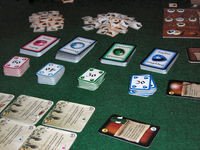
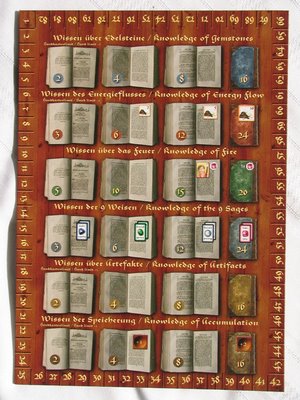
Scepter of Zavandor is probably the least successful in this regard. Players are always jockeying to get bigger better gems that will give them more income, but there is nothing about a diamond that makes it different in nature than an emerald other than income. Indeed, one of the key improvements that Jens Droegemueller incorporated over the original "Outpost" design was to streamline all the different production levels. So diamonds and emeralds are pretty similar - but a player does need to decide which, if any, he'll go for. To make the jump to rubies does require an entirely different strategy. Instead of buying special artifact cards at auction, a player must advance on the "Knowledge of Fire" level. That's a great example of shifting gears. As players start to really expand their production, they hit a ceiling unless they abandon one growth path and start another. The alternative is to try to accellerate to the endgame by getting those big-VP sentinels. Nonetheless, Scepter has a certain sameness to it which hurts the game - especially considering its length.
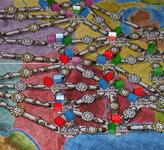
Power Grid uses the limitations of the map and the three plant limit to add new dimensions to the game. In the beginning, players are typically just finding the most efficient routes to build on. Eventually, they crash into each other and the game becomes more territorial as expanding out to the remaining available cities becomes a key strategic consideration. As the endgame approaches, players confront a new challenge: how to trade up efficiently so that the total of all three plants puts them over the top for reaching victory conditions. This can be very tricky because often the "best" available plant is very economical, but it isn't good enough for final victory. Players must manage the decision of whether to hold out - producing at a suboptimal level for some game turns - or to invest money in a plant which is efficient, but which will require yet another plant to be replaced.
Goa has many tools at its disposal to add variety: the many different tracks that a player may choose to build on, as well as the differing types of commodities that a player must collect. However, I feel that like Scepter of Zavandor, Goa falls a little short in its ability to provide different types of experience to the players as it progresses. Finding the right commodity needed to advance is important in the endgame- but it is always important. If there is any gear shifting that goes on, it is in the need to switch from a strategy that maximizes productive capacity to a strategy that maximizes victory points. By the time players are getting to the end, they can often produce more stuff than they can reinvest. It is at this point when a player is most likely to want to cash in oodles of spice for money. There can be some gross imbalances in a player's production and in the endgame some of the challenge comes from finding a use for it that will translate into victory points. In the middle and endgames, players confront the race to be the first to grow to the 4th and 5th levels in order to earn extra expedition cards. However, I think that the game would have benefitted from new restrictions or opportunities which would have made the endgame feel less like what came before it.
Sometimes a game won't suffer too much from sameness because it's sufficiently complicated that the players don't notice. To some degree all of the above games have that going for them. They require a lot of analysis and juggling of competing needs - enough so that players are too busy to feel that the last turn is similar to the first ones. In fairness, late game positions in these games are not just scaled up versions of early game positions, but they all do have some elements of that.
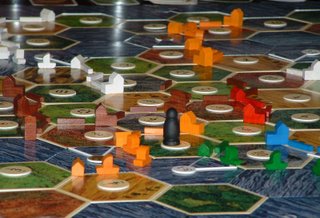
Settlers of Catan is the game among the four which I think has the best story arc. It has a lot going for it. It has a board which is much more textured than the Power Grid board, forcing players into new considerations as they expand away from the richest areas of the board into leaner ones. Players will also find the mix of commodities they produce to change significantly as the game evolves, which also forces different play styles. But the inclusion of the bonuses for longest road and largest knight force is a critical inclusion. It adds a new dimension to the game of pure expansion and creates heavy contests in the midgame and endgame. Consider the fact that earning either of these contributes 25% of the total points needed for victory - once you subtract the initial two points that all players begin with. Imagine what Goa would be like if the races for 4th and 5th levels contributed 2-3 points each. I can't promise that it would be a better game, but it would certainly add a new dimension to the game once players began approaching those levels.
Hey - think fast. In a business game, what are the victory conditions?
Here's the obvious answer: most money in the end wins. Here's the surprise: none of these games are determined by most money. Actually, that's a realistic result. In the real world, who cares about how much cash a company has? A company's value is determined by its future earnings expectations. In a game, that needs to be simplified and quantified in some objective manner, usually by evaluating a player's production capacity.
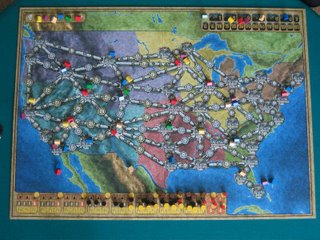
Power Grid, true to its relative realism, handles this in the most straightforward manner. The player who can supply energy to the most cities wins. This is really another way of saying: the player with the most annual revenue at the end of the game wins. Of course, if the game were to play out another turn, that could change. Fuel might become unavailable. Also, the game measures total revenue and ignores the "operating cost" (of fuel) that the player incurs. But overall, this is a pretty good measure of a player's earning potential.
Settlers works in a similar way, rewarding the quantity of settlements and cities - the main production units - as the primary source of victory points, and then adds in the bonuses for longest road and largest army - principally (in my opinion) to just add another dimension of gameyness go give players alternative paths to aim for.
Scepter of Zavandor departs most significantly from its roots as an economic development game by giving victory points for non-productive assets, especially the "Sentinels".

The sentinels in Zavandor are similar to the large buildings in Puerto Rico. They are ways of converting lots of money into lots of victory points (but no other advantages), where the quantity of points depends on other conditions you've achieved during the game. In a way, this is really just a way of awarding VP's for having money. It merely adds another game step of making big stacks of cash (yeah, yeah, "energy") convert into VP's by requiring players to auction off the sentinels, and having their VP value contingent on other strategies that the player has pursued. It's a good enough solution. It is, at least, more interesting than just awarding 1 point for every 10 energy points. But even if having a player buy a bunch of seemingly useless sentinels has no business parallel, ("great, I just bought a statue of a giant frog") it is also more satisfying to actually own something physical than to count gobs of cash at the game end. Additionally, these mechanisms help to create end-game conditions, and they provide players with a use for resources that would otherwise escalate to a point that becomes meaningless. If Scepter of Zavandor, or any of these games, ended when one player accumulated a certain quantity of money or commodities, the endgame would seem like a let down. Players would start accumulating more resources than they had outlets to spend them on, and the whole exercise would be begin to seem pointless.
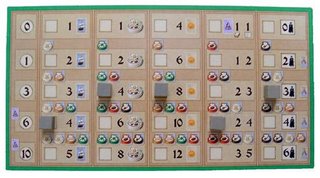
Goa addresses victory conditions in the least realistic and most game-y manner. Goa assigns varying victory points to a variety of conditions, most notably the advancement levels that a player has in each track. Moreover, the victory points are not proportional. For any given track, the first level is worth 1 point, then an incremental 2 points, then 3, and so on. Ultimately, this does parallel the notion of awarding points for productive assets. It is game-y in the way that values escalate. Now if you look at any given track, the actual production of a track tends to be stepwise. On the ship track, the first step produces one ship, then two ships, then three and so on. One more ship per level. But the points are 1 VP for reaching the first level then 3 VP for reaching the second, then 6 for reaching the third, and so on in a triangle function. This was clearly a conscious sacrifice of realism in order to inject more agonizing decisions into the game. If all levels paid off proportionally, players would tend to build their levels equally, benefitting from being able to play a balanced strategy. Instead, Rudiger Dorn forces players to go against their natural desires and instead to shoot for the big payoff.
These escalating payoff tables are commonly used in many games to provide players with potentially big payoffs which add to the excitement of the game.
In most of Klaus Teuber's subsequent settlers games and historical scenarios, Teuber pretty much forces players to invest in non-productive ventures. In Cheops, for example, players must allocate commodities to building the pyramid, and they will gain or lose considerable victory points depending on their relative contributions. I've always hated these mechanisms. Hey, I'm running a business here. I'm trying to build something
productive. Why are you wasting my valuable resources with the need to build some pile of crap for a stinkin' monarch? It only made matters worse that players are in perpetual competition with each other to waste more resources than anyone else. Fall behind, and you lose VP's. Thematically, Teuber made these diversions less offensive in later games. In The Great Wall of China scenario, for example, players need to contribute to building the wall in order to keep those nasty Huns away. I guess I'd rather pay for defense than for tribute.
The effect of having nonproductive uses for resources is very different in the Catan games than it is in Zavandor (or Puerto Rico). In Zavandor and Puerto Rico, the decision to buy Sentinels or Large Buildings is always an endgame move. After a player has done everything possible to expand his productive capacities, these choices become alternative ways to store value (VP's). They accellerate the endgame and don't really compete with the need to build things that provide more money. On the other hand, the need to invest in walls or pyramid blocks or knights in the Catan games can't wait until the end. In some cases, players need to actively build the stuff early on or else be attacked by Barbarians, Pirates, Huns, or government bureaucrats. Additionally, players often need to secure specific non-productive positions on the game map early on, or else risk being closed out of them by the game's end.
There is a tradeoff in designing the game this way. As irritating as I may find these wasteful uses of resources to be, I certainly respect them as game mechanisms. They absolutely encourage player interaction and alleviate the incremental nature of business games by adding a bomb, in the form of a competition for some very valuable victory points. On the other hand, they can detract from letting players pursue the core strategy of building a production empire, which for me is the heart and soul of what makes these games interesting.
So what can we take away from all of this? I think that the most critical component to making a game of economic development interesting is finding the road blocks to pure growth. Each of the games we've looked at introduce limits to growth as a key mechanism. Potentially, these can enhance the sense of story arc in a game as players grow and begin to bash their heads against each other - or the game's own ceiling - and are forced into new directions. These games also benefit from presenting players with alternative paths to growth - whether in the form of different commodities which may come into play in different ways as the game evolves, or in the form of varying growth paths such as are found in Scepter of Zavandor and Goa. They introduce strategic options into the game and can help to alleviate the runaway leader problem that is a danger in this genre. The best games are designed to insure that trailing players can find potential shortcuts to growth which don't force them to follow in a leader's footsteps. These designers have also shown that there are very different ways of incorporating player interaction. They can range from the direct interaction found in the trading phase of Settlers of Catan to the head-butting found on the map in Power Grid to the inter-turn auctions of Goa. But they only work when small changes can make a big difference to the players. The auctions in Goa work because they can provide players with opportunities which can radically affect the decisions made in the solotaire portion of the game.
I have heard that some designers have no interest in creating games around business subjects because this is something that can be done in real life better than it can be done in a game. That may be true, but few of us have the opportunity to be corporate CEO's - much less renaissance traders. I find that business games are one of the great opportunities in gaming to engage in a real-life fantasy, and one which doesn't involve hacking, slashing, or overrunning armored military units.
I deliberately chose to look at these four games because they are so different from one another. Some don't even look like business games - but they all approach the common situation of enabling players to start with meager resources and to use them to build an economic empire. Each is an excellent game and together they show the breadth of possibilities that great game designers have created in the genre.

 to be impersonal. Players must, for example, consider when to produce and when to ship, and these choices can have substantial impact upon opponents. Players will often strategize in a way to avoid producing the same key commodity as their right hand neighbor in order to avoid getting shut out in a trading round. But look at how that is couched: avoid mirroring your right hand neighbor as opposed to, say, avoid mirroring a very aggressive player. When making tactical decisions in Puerto Rico, the consideration is overwhelmingly based on the way that decision affects the complicated interactions of player positions - who is a strong producer, who is vulnerable to having goods thrown overboard, etc. These decisions generally play out in a clear and predictable manner once you understand the game. The interactions in Puerto Rico are important but generally impersonal. Players keep their eyes on the playing mats as they ponder the next best move. A game with greater interaction gets players to also look not only at their opponents positions, but into their eyes as well.
 Compare Puerto Rico with a game like "Louis XIV" by Rudiger Dorn. Louis XIV is a majority-control game in which many contested areas have a "do-or-die" element. "I really-really-really need a helmet to insure that I can complete one of my missions this turn. I think I can take it by putting two units on the Dauphin - but what is Bryan going to do? It looks as though he'd be better off spreading his units across several nearby characters, but Bryan is the sort of guy who likes to play defensively and smack people down when they look like a threat. But I'd really like to place my third unit on Louvois, where I think I can pick up an easy influence card..."
 Challenges for control of a resource take place in games ranging from Power Grid to Caylus to Age of Steam. In Power Grid, only one of us is going to get into that nearby city, and if I can get there before you, I force you to expand into a more expensive city - or none at all. In Caylus, all players are competing for the benefits on the tiles, and with the use of the provost, I can even insure that nobody gets the use of certain tiles. There is also the competition for the extra favor provided by building the castle, which only one player can get each turn. In Age of Steam, I am challenging you for control of key routes, and also threatening to deliver goods and deprive you of them.
 to Ride" and "Through the Desert". In each case, players are expanding their reach over the map knowing that, at any given time, only one person can stake a claim to certain assets - whether it is a route or a water hole. What makes it especially warm is the degree of uncertainty in your opponent's move. How long can I continue to draw cards before Albert would take one of my key routes away from me? I'd like to make a move toward that oasis - but will Kelly take the two point watering hole I wanted, or will she leave me alone and take the one near Jason?
 There is some debate over how much Andreas Seyfarth's "Thurn & Taxis" is too much of a solitaire game. One element of player interaction in the game is the fact that players are racing to pick up scoring bonuses. The sooner you fill up the green area (for example), the more points you score for it. Your decision to fill up the green area is very dependent on what cards are coming up - and the same holds true for your opponent. Most of the time, either of you are going to create a route that fills in an area whenever it works best for you given other considerations. How many stations can I play if I extend the route? What cards came up? Rarely is a player going to try to anticipate the motivations of his opponent to make competing choices. Opponents seem like impartial movers who make the best tactical decisions based on circumstance.
 The "Why me?" effect is what can make multiplayer war games so much more contentious than two player war games. You can't exactly get ticked-off when your Memoir '44 opponent takes out one of your tanks. That's his job! But when he kicks you out of a region in Shogun/Wallenstein - well that's NOT his job! His job is to pick on the other guy, and leave you alone, right? When you're in that position, the choice to attack Aaron versus Erin isn't totally strategic. You're also going to consider what their reactions will be - both emotionally and strategically. Aaron tends to blow up and immediately counterattack, but he's better off going south and hitting Ryan. Erin is cooler, but she's in a corner and has no one to hit except for you. How do you choose? Your answer depends on the players, not just the game.
 The "why me?" effect isn't for everyone because it can create bad feelings in a game. I think that those bad feelings are strongest when the choice of who gets picked-on is most capricious, and it is weaker when there is some tactical excuse behind the decision. The perfect balance is a matter of taste. At one end of the spectrum is a game like Stefan Dorra's "Intrigue". In this game, players are doling out financially advantageous favors to selected players - based partly on bribes but ultimately selected out of whim. You just offered me $4,000, Mike just offered me $2,000; I keep both of your bribes and I give the position to... Mike. Somewhere toward the other end of the spectrum is a game like Kramer and Ulrich's "El Grande". In this game of majority controlled regions, I might have the opportunity to either take control of Valencia away from you or to take control of Old Castle away from Richard. The choice is entirely mine, but when I choose to attack you, it may be because I can better defend Valencia, and not just that I chose to pick on you.

 There is an important case where hidden information destroys warm player interaction. It is when you don't know which player controls which pieces. This is a mechanic I strongly dislike. It is seen in games such as "Clans", "Top Secret Spies", and "Drunter & Druber". In these games, players are dealt a card, face down, indicating which color pieces they control. During the game, they may make moves which might benefit any color - with the purpose of advancing their own position, but not in so obvious a way that would tip off other players as to which color they control. At the end of the game, when "red" wins, players reveal their cards to see who was playing red.
 This is a shortcoming of Thurn & Taxis. A part of the competition in this game involves taking cards away from opponents who might otherwise need them. However, it's a pretty abstract and indirect process to visualize this. I need to look at the route of area cards that my left-hand opponent is collecting, check the board to see what areas are adjacent to his route, then check the card display to see if any of those areas are currently available, and finally check my own card display to see if I can use the card that I'd like to take away from my opponent.
 Imagine how differently the game would feel if the six available areas on the board had a black pawn on them. As a player takes a pawn (instead of a card), he puts down a marker to indicate that it is part of the chain he is building. (Note that this would not conform to the actual rules of Thurn & Taxis because in the game, players do not immediately add cards taken to their route but instead take them into their hand for later play.) In this scenario, players are all engaged together in the same space. I can see exactly where you need to go and I can see exactly where you can go. By playing in the same space, players have a greater awareness of their relationships with one another and will naturally play more actively against each other. This sort of scenario is closer in spirit to "Ticket to Ride", where everyone's position, and their potential to block, is right out there. It's one reason that I prefer "Ticket to Ride" over "Thurn & Taxis".
 Doyle talks at greater length about what he wanted to achieve with this design on his site,